


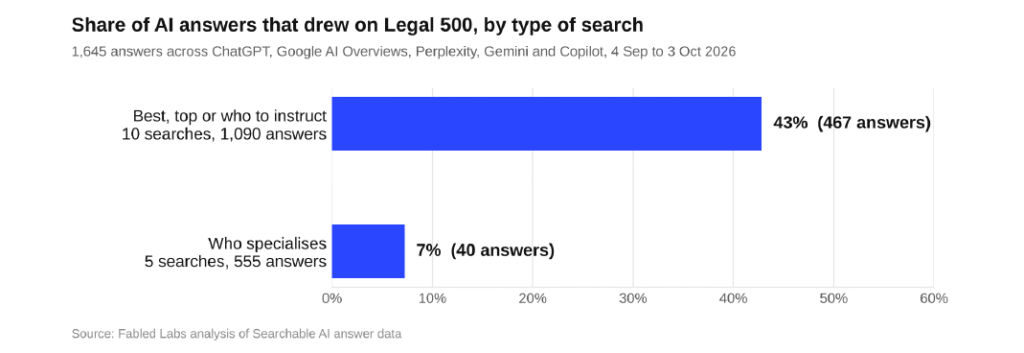
Fabled Labs analysed 1,645 AI answers to 15 high-value legal searches. Legal 500 appeared in 43% of answers asking who was ‘best’, ‘top’ or who to instruct, compared with 7% of searches asking who specialised in an area. The 43% covers all platforms, and they differ: across all search types, ChatGPT used Legal 500 in 55% of its answers.
How often does AI use Legal 500 when it recommends lawyers?
In Fabled Labs’ analysis of 1,645 AI answers to 15 high-value legal searches, collected between 4 September and 3 October 2026, Legal 500 was among the pages AI read in 31% of answers. That rose to 43% when the search asked who was ‘best’, ‘top’ or who to instruct, and fell to 7% when it asked who specialised in an area. Those figures cover all platforms, and platforms differ. Across all search types, ChatGPT used Legal 500 in 55% of its answers and Legal 500 or Chambers and Partners in 87%. On that Legal 500 or Chambers measure, Perplexity was 44%, Google AI Overviews 43%, Gemini 15% and Copilot 10%. Gemini and Copilot were tracked only from 25 September, with 140 answers each. AI appears to read law firms’ own websites to understand expertise, then lean on independent rankings when asked to choose.
What did we find?
Legal 500 was used as a source in 507 of the 1,645 AI answers we analysed, or 31%. The wording of the search changed that figure sharply.
- Best, top or who to instruct: Legal 500 was used in 43% of answers (467 of 1,090).
- Who specialises in an area: Legal 500 was used in 7% of answers (40 of 555).
- ChatGPT: Legal 500 was used in 55% of its answers (251 of 455). Legal 500 or Chambers and Partners was used in 87% (394 of 455). Other platforms, Legal 500 or Chambers and Partners: Perplexity 44%, Google AI Overviews 43%, Gemini 15% and Copilot 10%. All figures here cover every search type. Gemini and Copilot were tracked from 25 September only.
- What AI read: for best, top and instruct searches, 56% of all the pages AI read were directories, rankings and lists. For specialist searches, 73% were law firm and chambers websites.
The strongest single example
For the search ‘Which chambers should I instruct for a high-value financial remedy case in London?’, Legal 500 appeared in 96 of 108 AI answers, or 89%.
No single Legal 500 page explains that figure. AI drew on several, including the London Bar rankings tables for financial remedy and individual chambers’ ranking pages. The most-used page appeared in 54 of the 108 answers. Counted across the whole Legal 500 site, the figure was 89%.
This matters for anyone measuring AI visibility. Looking only at the most-cited page understates how much influence a source has.
Why does this matter after this week’s Legal 500 error?
On Thursday 1 October 2026, Legal 500 published the latest edition of its annual United Kingdom (Bar) rankings. The next day, it took its website offline after critical testimonial material appeared on barrister profiles.
Legal 500 said that during a website update, ‘an error in the upload process resulted in a small amount of testimonial information being published incorrectly’. It said it removed the content as soon as it became aware and would strengthen its quality assurance.
We checked whether that material reached AI answers. We reviewed 705 AI answers to barrister searches recorded between 1 and 3 October 2026. None reproduced the incorrect testimonials. The window was short and the site was offline for part of it, so this shows no evidence of spread, not proof that it could not happen.
The incident still raises a bigger question. Third-party reputation sources now feed the AI systems that answer questions once handled by directories, search engines and referrals. When AI leans on a source, the accuracy of that source matters to every firm it describes.
The timing matters too. Ahrefs data shows UK searches for ‘legal 500’ peak every October, at more than 14,000 in both October 2024 and October 2025, around two and a half times the August level. This is the season when firms, clients and AI systems pay most attention to the directories.
Does AI behave differently when asked to choose a lawyer?
Yes, in our data. When a search asks who specialises, AI mostly reads law firms’ own websites. When it asks who is best or who to instruct, it turns to independent rankings.
- Specialist searches: 73% of the 6,194 pages AI read were law firm and chambers websites. 24% were directories, rankings and lists.
- Best, top and instruct searches: 56% of the 14,433 pages AI read were directories, rankings and lists. 40% were law firm and chambers websites.
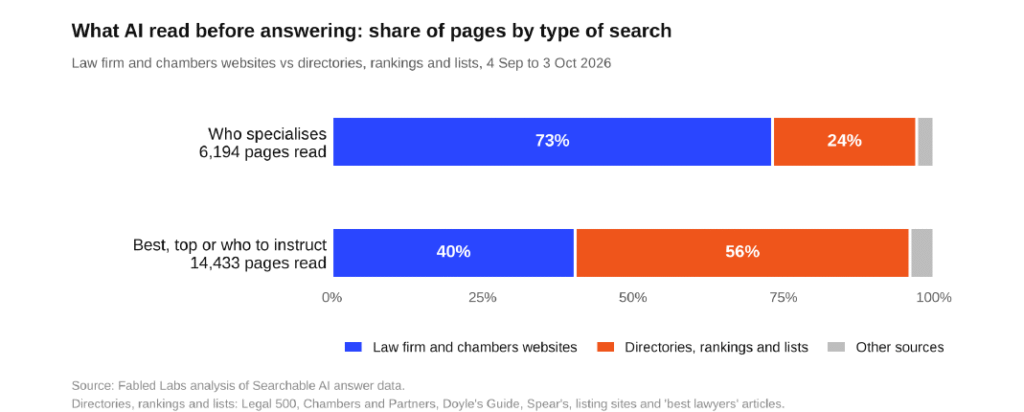
The pattern held within each tracked set that included both types of search. Across our three sets, directories, rankings and lists made up between 51% and 64% of the pages AI read for best and instruct searches. For specialist searches, the figure was between 20% and 31%.
Legal 500 drives much of the difference. Chambers and Partners was used in both types of search: in 43% of best and instruct answers, and 37% of specialist answers.
One explanation is the nature of the question. ‘Who specialises in this?’ can be answered from a firm’s own pages. ‘Who is best?’ and ‘Who should I instruct?’ require a judgement between firms, and AI appears to borrow that judgement from sources it treats as independent.
This is an initial observation rather than a proven causal relationship. We identified the split after reviewing the data, and we are now testing it in a larger study designed in advance.
I see this pattern regularly in client work. A firm can have clear, well-written pages about its expertise and still be missing from AI’s shortlist, while competitors with a stronger presence in directories and the legal press are named instead. Fixing the website helps AI understand a firm. On its own, it rarely gets that firm recommended.
Where else does AI look when it recommends lawyers?
Not only at the established directories. One in three answers (541 of 1,645) drew on articles listing the ‘best’ lawyers that were published on business, technology, retail and marketing websites rather than legal publications.
One ‘Top 10’ guide to high net worth divorce lawyers, hosted on a retail industry website, was used in 181 answers, or 11%. Ahrefs estimates that several of the sites hosting these lists receive fewer than 200 UK visits a month.
AI weighs established directories alongside lists from sites with little legal readership. A page being used as a source does not mean AI weights it as highly as Legal 500. For firms, that makes it important to know exactly which sources AI is reading about their practice area.
What does this mean for law firms?
Owned content helps AI understand what you do. Independent authority helps AI decide whether to recommend you.
AI answers are becoming the front door to professional services. A prospective client can ask ChatGPT who to instruct before they ever see a firm’s website. We call this the Front Door Problem.
Our data suggests the website alone does not decide what happens at that door. In around half of the times AI named a firm (5,475 of 10,351 mentions in our count), that firm’s own website was not among the pages it read. On ChatGPT, the figure was 73% (2,366 of 3,254). Our domain matching covered 92% of firm sites, so both figures lean slightly high.
Recommendations also move. The first firm AI named for the same search changed from one day to the next 56% of the time (664 of 1,193 consecutive-day comparisons across ChatGPT, Perplexity and Google AI Overviews). A one-off check tells a firm very little.
So AI visibility is not only about publishing more website content. It is likely to involve:
- Directory submissions and well-prepared referees
- PR and media coverage in legal and business press
- Expert commentary and bylined articles from named lawyers
- Consistent lawyer and firm profiles across the website, directories, LinkedIn and regulator registers
- Client reviews, where appropriate
- Clear website pages that state expertise plainly, so AI understands it
In our CITE framework, a firm’s own site carries Identity and Evidence. Directories, press and reviews carry Credibility and Trust. AI recommendation appears to need both.
What are we testing next?
We are extending the research beyond family law into commercial litigation, international arbitration, employment, real estate disputes and group litigation.
The next study uses 50 searches defined before any data is collected, split between specialist, ‘best’ and ‘who should I instruct’ wording. We will measure Legal 500 and Chambers and Partners side by side, across the same five AI platforms, and track how sources change over time. We will publish the results when the study is complete.
If the pattern holds outside family law, it changes how firms should invest in AI visibility.
Methodology
- Period: 4 September to 3 October 2026.
- Answers analysed: 1,645.
- Searches: 15 high-intent legal searches. 10 asked who was best, top, leading, recommended or who to instruct. 5 asked who specialised in, or had expertise in, an area.
- Practice area: mainly high-value family law and family Bar searches, London and UK-wide.
- Platforms: ChatGPT, Google AI Overviews and Perplexity, daily. Gemini and Copilot, daily from 25 September 2026.
- Data: AI answers collected with Searchable. Search demand and site traffic estimates from Ahrefs (UK).
- Definition of ‘used’: the source appeared among the pages the AI system accessed to generate its answer, whether or not it was shown as a visible citation. An answer counts once, however many pages from the same site it used.
- Page shares: based on every page accessed across all answers (20,627 pages).
- Search selection: drawn from Fabled Labs’ ongoing AI search tracking and reported in aggregate. No client is identified.
- Limitations: the searches focus on family law. The split between recommendation and specialist searches was identified after reviewing the data and is being tested prospectively. Gemini and Copilot contributed fewer answers (140 each). Domain matching covered 92% of firm sites, so the share of firm mentions where the firm’s own site was not read leans slightly high. AI answers vary from day to day.
Frequently asked questions
Does AI copy Legal 500’s rankings?
Not directly. AI used Legal 500 pages in 31% of the answers we analysed, usually alongside other sources such as Chambers and Partners and law firm websites. Using a page as a source is not the same as repeating its rankings
Did the incorrect Legal 500 testimonials appear in AI answers?
We found no evidence that they did. We reviewed 705 AI answers to barrister searches recorded between 1 and 3 October 2026, and none reproduced the incorrect testimonial material.
Which AI platform relies most on legal directories?
ChatGPT, in our data. Across all search types, it drew on Legal 500 or Chambers and Partners in 87% of its answers. The figures for the other platforms were 44% for Perplexity, 43% for Google AI Overviews, 15% for Gemini and 10% for Copilot. Gemini and Copilot were tracked only from 25 September.
Can a law firm pay to appear in AI recommendations?
We found no sponsored advertisements in the AI answers we tracked between 4 September and 3 October 2026. The recommendations we saw were built from published web sources
.How can a law firm find out what AI says about it?
Track the searches prospective clients actually use, across several AI platforms, over weeks rather than once. Then look at which sources each answer drew on. Fabled Labs’ AI Recommendation Audit does this for a firm and its competitors.
Final word
AI has not replaced the legal directories. In our data, it leans on them most at the moment a client is choosing who to instruct.
Firms that want to be recommended need two things: a website that explains clearly what they do, and independent evidence that others rate them. The firms AI recommends will be the ones that have both.
Sources
- Legal Cheek, ‘Legal 500 apologises after publishing incredibly harsh reviews of barristers in website update error’, October 2026. https://www.legalcheek.com/2026/10/legal-500-apologises-after-publishing-incredibly-harsh-review-of-barristers-in-website-update-error/
- Non-Billable, ‘Legal 500 takes website offline after critical barrister reviews appear’, 2 October 2026. https://www.nonbillable.co.uk/news/legal-500-takes-website-offline-critical-barrister-reviews
- City AM, ‘Legal 500 takes down site after accidentally publishing damning barrister reviews’, October 2026. https://www.cityam.com/legal-500-takes-down-site-after-accidentally-publishing-damning-barrister-reviews/
- RollOnFriday, ‘Legal500 accidentally publishes terrible reviews of top barristers’, October 2026. https://www.rollonfriday.com/news-content/exclusive-legal500-accidentally-publishes-terrible-reviews-top-barristers
- Fabled Labs analysis of AI answer data collected with Searchable, 4 September to 3 October 2026.
- Ahrefs Keywords Explorer, UK search volume history for ‘legal 500’, accessed 3 October 2026.
- Ahrefs Site Explorer, UK organic traffic estimates, accessed 3 October 2026.
This article reports research by Fabled Labs based on AI answers collected between 4 September and 3 October 2026. AI outputs change frequently, and results may differ for other searches, locations and dates. Legal 500 and Chambers and Partners are independent publications. Fabled Labs is not affiliated with either, and this article does not comment on the merits of any ranking or firm. This article is for information only and is not legal advice.