

In around half of the times AI named a law firm, the firm’s own website was not among the pages it read.
Does a law firm’s website decide whether AI recommends it?
Not on its own, in our data. In around half of the times AI named a firm, that firm’s own site was not among the pages it read. On ChatGPT, the figure was 73%. Our domain matching covered 92% of firm sites, so both figures lean slightly high.
Key takeaways
- In around half of mentions (5,475 of 10,351), the firm’s own website was not among the pages AI read. On ChatGPT it was 73% (2,366 of 3,254).
- For ‘who specialises’ searches, 73% of pages read were law firm and chambers websites, so the site still matters. This is a different 73%.
- Both not-read figures lean slightly high, because domain matching covered 92% of firm sites.
What did we find?
This article draws on the same 1,645 AI answers as our Legal 500 research, collected between 4 September and 3 October 2026.
- Firm site not read: in around half of mentions (5,475 of 10,351 in our count), the firm’s own website was not among the pages AI read.
- On ChatGPT: 73% of mentions (2,366 of 3,254).
- Specialist searches: 73% of the 6,194 pages AI read were law firm and chambers websites. This is a different 73% from the ChatGPT figure.
- Best, top and instruct searches: 56% of the 14,433 pages AI read were directories, rankings and lists. 40% were law firm and chambers websites.
Does my firm’s website matter to AI?
A law firm’s website matters to AI because it is where AI finds out what the firm does. When a search asked who specialised in an area, AI mostly read law firms’ own sites. 73% of the 6,194 pages it read were law firm and chambers websites, and 24% were directories, rankings and lists.
The website is where AI finds out what a firm does. That part of the picture is encouraging for firms that have invested in clear, specific pages.
Why is a good website not enough?
A good website is not enough because AI can name a firm without reading its site. In around half of the times AI named a firm (5,475 of 10,351 mentions in our count), that firm’s own website was not among the pages it read. On ChatGPT, the figure was 73% (2,366 of 3,254).
This is a different 73% from the share of pages read on specialist searches, above. One is a share of pages. The other is a share of firm mentions.
| Measure | Value | Base |
|---|---|---|
| Firm’s own site not among the pages read, all firm mentions | 53% (around half) | 5,475 of 10,351 mentions |
| Firm’s own site not among the pages read, ChatGPT mentions | 73% | 2,366 of 3,254 mentions |
| Law firm and chambers sites, share of pages read on specialist searches | 73% | 6,194 pages |
Table 1. Two different 73% figures, and the overall figure. The two not-read figures lean slightly high.
Our domain matching covered 92% of firm sites, so both figures lean slightly high. In those cases, other sources appear to have supplied the recommendation.
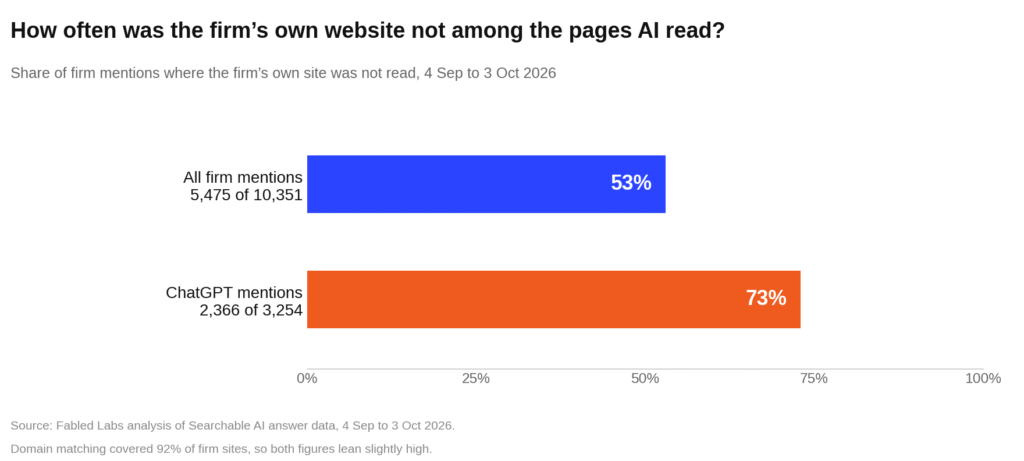
Figure 1. How often the firm’s own website was not among the pages AI read.
What does AI read when asked who is best?
When asked who is best, AI reads rankings, directories and lists more than firm websites. For best, top and instruct searches, 56% of the 14,433 pages AI read were directories, rankings and lists, against 40% law firm and chambers websites.
Across our three tracked sets, directories, rankings and lists made up between 51% and 64% of the pages AI read for best and instruct searches. For specialist searches, the figure was between 20% and 31%.
This is an initial observation rather than a proven cause. We identified the split after reviewing the data, and we are now testing it in a larger study designed in advance.
What should a managing partner ask first?
The first question a managing partner should ask is not “is our website good enough?” but “which sources is AI reading about us?” The first question is about the firm’s own door. The second is about where the answer is built.
AI answers are becoming the front door to professional services. A prospective client can ask ChatGPT who to instruct before they ever see a firm’s website. We call this the Front Door Problem. We look at how independent sources fill the gap in why independent validation shapes who AI recommends.
In our data, the answer was often built without the firm’s site. A firm can do everything right on its own pages and still be missing from the shortlist.
What should a firm check first?
A firm can find out what AI says about it by running the searches clients actually use, across several platforms, over weeks:
- Run the searches clients actually use, across several AI platforms.
- Repeat them over weeks, not once. Recommendations move.
- Note which sources each answer drew on.
- Compare your firm with the competitors AI names instead.
- Check that profiles across the website, directories, LinkedIn and regulator registers say the same thing.
Anything a firm publishes about itself, including claims about expertise, should stay within SRA rules on publicity: accurate and not misleading.
My view: hold two lists
The natural instinct is to improve the website, and I understand it. It is the part a firm controls.
But the data suggests the website is one half of the picture. I would ask a managing partner to hold two lists: what we say about ourselves, and what others say about us. AI appears to read both, and to lean on the second when it is asked to choose.
That is why I am wary of audits that stop at the website. A technically sound site can still be missing from the answer.
Sean O’Dwyer Curran
What are we testing next?
We are extending the research beyond family law into commercial litigation, international arbitration, employment, real estate disputes and group litigation. The next study uses 50 searches defined before any data is collected, split between specialist, ‘best’ and ‘who should I instruct’ wording. We will measure Legal 500 and Chambers and Partners side by side, across the same five AI platforms, and track how sources change over time. We will publish the results when the study is complete.
Methodology
- Period: 4 September to 3 October 2026.
- Answers analysed: 1,645.
- Searches: 15 high-intent legal searches. 10 asked who was best, top, leading, recommended or who to instruct. 5 asked who specialised in, or had expertise in, an area.
- Practice area: mainly high-value family law and family Bar searches, London and UK-wide.
- Platforms: ChatGPT, Google AI Overviews and Perplexity, daily. Gemini and Copilot, daily from 25 September 2026.
- Data: AI answers collected with Searchable. Search demand and site traffic estimates from Ahrefs (UK).
- Definition of ‘used’: the source appeared among the pages the AI system accessed to generate its answer, whether or not it was shown as a visible citation. An answer counts once, however many pages from the same site it used.
- Page shares: based on every page accessed across all answers (20,627 pages).
- Firm mentions: 10,351 mentions of firms in our count, 3,254 of them on ChatGPT. A firm’s own site counted as read if its domain was among the pages accessed. Domain matching covered 92% of firm sites.
- Search selection: drawn from Fabled Labs’ ongoing AI search tracking and reported in aggregate. No client is identified.
- Limitations: the searches focus on family law. The split between recommendation and specialist searches was identified after reviewing the data and is being tested prospectively. Domain matching covered 92% of firm sites, so the share of firm mentions where the firm’s own site was not read leans slightly high. AI answers vary from day to day.
Frequently asked questions
Why doesn’t ChatGPT recommend my law firm?
Our data cannot answer that for any single firm. It does suggest that a strong website is not enough on its own. On ChatGPT, the firm’s own site was not among the pages read in 73% of the mentions we counted, so the sources behind the recommendation matter.
Does AI read my firm’s website?
Sometimes. For ‘who specialises’ searches, 73% of the pages AI read were law firm and chambers websites. When AI named a firm, in around half of mentions the firm’s own site was not among the pages it read.
How reliable is the 73% ChatGPT figure?
It leans slightly high. Our domain matching covered 92% of firm sites, so some sites may be counted as not read when they were read. The direction is clear, but the precise figure should be treated with care.
Do these results apply outside family law?
We do not know yet. The searches focus on family law. We are testing the pattern across commercial litigation, international arbitration, employment, real estate disputes and group litigation.
How can a law firm find out what AI says about it?
Track the searches prospective clients actually use, across several AI platforms, over weeks rather than once. Then look at which sources each answer drew on. Fabled Labs’ AI Recommendation Audit does this for a firm and its competitors.
Final word
A good website is the entry ticket, not the whole case. In our data, AI often named firms without reading their sites, and leaned on independent sources when asked to choose. Firms that want to be recommended need a website that explains clearly what they do, and independent evidence that others rate them.
Sources
- Fabled Labs analysis of AI answer data collected with Searchable, 4 September to 3 October 2026.
This article reports research by Fabled Labs based on AI answers collected between 4 September and 3 October 2026. AI outputs change frequently, and results may differ for other searches, locations and dates. Legal 500 and Chambers and Partners are independent publications. Fabled Labs is not affiliated with either, and this article does not comment on the merits of any ranking or firm. This article is for information only and is not legal advice.