

When AI is asked who specialises, it reads firms’ websites. When it is asked who is best, it turns to rankings and lists.
Does AI rely on independent sources to recommend lawyers?
Yes, when asked to choose. For specialist searches, 73% of the pages AI read were law firm and chambers websites. For ‘best’ and ‘instruct’ searches, 56% were directories, rankings and lists. This is an initial observation from mostly family law searches, not a proven cause.
Key takeaways
- Specialist searches: 73% of pages read were firm and chambers websites. Best and instruct searches: 56% were directories, rankings and lists.
- Legal 500 was used in 43% of best and instruct answers and 7% of specialist answers. Chambers and Partners was 43% and 37%.
- Independent validation means evidence about a firm that the firm does not control. This is an initial observation, not a proven cause.
What did we find?
This article draws on the same 1,645 AI answers as our Legal 500 research, collected between 4 September and 3 October 2026.
- Specialist searches: 73% of 6,194 pages were law firm and chambers websites. 24% were directories, rankings and lists.
- Best, top and instruct searches: 56% of 14,433 pages were directories, rankings and lists. 40% were law firm and chambers websites.
- Across our three tracked sets, directories, rankings and lists made up 51% to 64% of pages read for best and instruct searches, and 20% to 31% for specialist searches.
- Legal 500 was used in 43% of best and instruct answers and 7% of specialist answers. Chambers and Partners was used in 43% and 37%.
What changes when AI is asked to choose?
When AI is asked to choose, it turns from firms’ own pages to independent sources. For specialist searches, 73% of the pages AI read were law firm and chambers websites. For best and instruct searches, 56% were directories, rankings and lists, and 40% were firm and chambers websites.
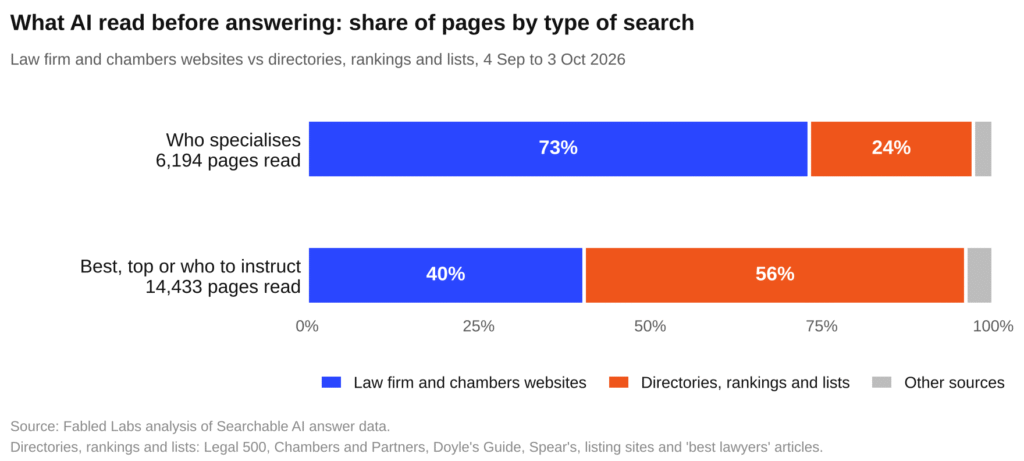
Figure 1. What AI read before answering, by type of search.
The pattern held within each tracked set that included both types of search. One explanation is the nature of the question. ‘Who specialises in this?’ can be answered from a firm’s own pages. ‘Who is best?’ requires a judgement between firms, and AI appears to borrow that judgement from sources it treats as independent.
This is an initial observation rather than a proven cause. We identified the split after reviewing the data, and we are now testing it in a larger study designed in advance.
Is Chambers and Partners only a ‘best’ source?
Chambers and Partners is not only a ‘best’ source: it was used in both types of search, in 43% of best and instruct answers (471 of 1,090) and in 37% of specialist answers (203 of 555).
Legal 500 is where the gap opens. It was used in 43% of best and instruct answers (467 of 1,090) and 7% of specialist answers (40 of 555).
| Source | Best and instruct answers | Specialist answers |
|---|---|---|
| Legal 500 | 43% (467 of 1,090) | 7% (40 of 555) |
| Chambers and Partners | 43% (471 of 1,090) | 37% (203 of 555) |
Table 1. Use of each directory, by type of search.
So the two directories do not behave identically in our data. We will measure them side by side in our next study.
What counts as independent validation?
Independent validation is evidence about a firm that the firm does not control. In practice, that is likely to include:
- Directory rankings and profiles, supported by well-prepared referees.
- Coverage in the legal and business press.
- Expert commentary and bylined articles from named lawyers.
- Client reviews, where appropriate.
- Consistent profiles across directories, LinkedIn and regulator registers.
Reviews and testimonials need to be genuine and not selectively chosen. Publicity should stay accurate and not misleading, under SRA or BSB rules as relevant.
Why is more website content not the answer on its own?
More website content is not the answer on its own because a firm’s own pages cannot vouch for themselves. AI appears to look for evidence that others rate a firm, and a firm cannot supply that by publishing more of its own material. We show how often a firm’s own site is missing from the answer in why a good law firm website is not enough for AI to recommend you.
In our view, owned content and independent validation do different jobs. Owned content helps AI understand what you do. Independent authority helps AI decide whether to recommend you.
In our CITE framework, a firm’s own site carries Identity and Evidence. Directories, press and reviews carry Credibility and Trust. AI recommendation appears to need both.
Where should a firm start?
A firm should start with the sources AI already reads for its practice area. Find out which directories, publications and lists appear in AI answers for the searches your clients use. Then check whether your firm is present, accurate and consistent in each.
That is a narrower job than “build more authority”, and it is led by data. Few firms have the capacity to do everything, so start where the sources already shape the answers.
My view: a standard owned content cannot meet
I would rather a firm put its next effort into being accurate and present in the handful of sources AI already reads for its practice area than into another round of its own content. That is a judgement, not a finding, and it rests on one dataset.
Independent validation also has a standard that owned content does not. It has to be earned, it has to be accurate, and in a regulated sector it has to be honest. Reviews that are selected rather than genuine will damage a firm faster than a gap would.
The practical test I would use: could a stranger verify this claim about us without visiting our website?
Sean O’Dwyer Curran
What are we testing next?
We are extending the research beyond family law into commercial litigation, international arbitration, employment, real estate disputes and group litigation. The next study uses 50 searches defined before any data is collected, split between specialist, ‘best’ and ‘who should I instruct’ wording. We will measure Legal 500 and Chambers and Partners side by side, across the same five AI platforms, and track how sources change over time. We will publish the results when the study is complete.
Methodology
- Period: 4 September to 3 October 2026.
- Answers analysed: 1,645.
- Searches: 15 high-intent legal searches. 10 asked who was best, top, leading, recommended or who to instruct. 5 asked who specialised in, or had expertise in, an area.
- Practice area: mainly high-value family law and family Bar searches, London and UK-wide.
- Platforms: ChatGPT, Google AI Overviews and Perplexity, daily. Gemini and Copilot, daily from 25 September 2026.
- Data: AI answers collected with Searchable. Search demand and site traffic estimates from Ahrefs (UK).
- Definition of ‘used’: the source appeared among the pages the AI system accessed to generate its answer, whether or not it was shown as a visible citation. An answer counts once, however many pages from the same site it used.
- Page shares: based on every page accessed across all answers (20,627 pages).
- Page classification: pages read were classified by Fabled Labs as law firm and chambers websites, directories, rankings and lists, or other sources. The per-set range covers three tracked sets for best and instruct searches and two for specialist searches.
- Search selection: drawn from Fabled Labs’ ongoing AI search tracking and reported in aggregate. No client is identified.
- Limitations: the searches focus on family law. The split between recommendation and specialist searches was identified after reviewing the data and is being tested prospectively. Gemini and Copilot contributed fewer answers (140 each). AI answers vary from day to day.
Frequently asked questions
What is independent validation for a law firm?
Evidence about the firm that the firm does not control. That includes directory rankings, press coverage, expert commentary from named lawyers, client reviews where appropriate, and consistent profiles on third-party sites.
Does AI copy directory rankings?
Not directly. AI used Legal 500 pages in 31% of the answers we analysed, usually alongside other sources such as Chambers and Partners and law firm websites. Using a page as a source is not the same as repeating its rankings.
Do Legal 500 and Chambers and Partners work the same way for AI?
Not in our data. Legal 500 was used in 43% of best and instruct answers and 7% of specialist answers. Chambers and Partners was used in 43% and 37%. We will measure them side by side in our next study.
Can a law firm pay to appear in AI recommendations?
We found no sponsored advertisements in the AI answers we tracked between 4 September and 3 October 2026. The recommendations we saw were built from published web sources.
Where should a law firm start?
With the sources AI already reads for its practice area. Track the searches prospective clients use, across several platforms, over weeks. Then check whether the firm is present, accurate and consistent in each source. Fabled Labs’ AI Recommendation Audit does this for a firm and its competitors.
Final word
Owned content helps AI understand what you do. Independent authority helps AI decide whether to recommend you. In our data, AI leans on the second most when a client is choosing. The firms it recommends will be the ones that have both.
Sources
- Fabled Labs analysis of AI answer data collected with Searchable, 4 September to 3 October 2026.
This article reports research by Fabled Labs based on AI answers collected between 4 September and 3 October 2026. AI outputs change frequently, and results may differ for other searches, locations and dates. Legal 500 and Chambers and Partners are independent publications. Fabled Labs is not affiliated with either, and this article does not comment on the merits of any ranking or firm. This article is for information only and is not legal advice.